Showing posts with label Internet. Show all posts

Friday, June 22, 2012

How to Do Everything with JavaScript


Scott Duffy
McGraw-Hill/Osborne
New York Chicago San Francisco Lisbon
London Madrid Mexico City Milan New Delhi
San Juan Seoul Singapore Sydney Toronto

Contents at a Glance
Part I Learn JavaScript Basics
1 Prepare to Program in JavaScript . . . . . . . . . . . . . . . . . . . . . . . . . . . . . . . . 3
2 Learn JavaScript Fundamentals . . . . . . . . . . . . . . . . . . . . . . . . . . . . . . . . . 25
3 Use Built-in JavaScript Classes . . . . . . . . . . . . . . . . . . . . . . . . . . . . . . . . . 63
4 Organize Data into Arrays . . . . . . . . . . . . . . . . . . . . . . . . . . . . . . . . . . . . . 95
5 Create Your Own JavaScript Classes . . . . . . . . . . . . . . . . . . . . . . . . . . . . . 117
Part II Build JavaScript-Enabled Web Sites
6 Embed JavaScript in a Web Page . . . . . . . . . . . . . . . . . . . . . . . . . . . . . . . . 141
7 Create Scripts That Work in Every Browser . . . . . . . . . . . . . . . . . . . . . . . . 161
8 Manipulate Web Forms . . . . . . . . . . . . . . . . . . . . . . . . . . . . . . . . . . . . . . . . 179
9 Handle Browser Events . . . . . . . . . . . . . . . . . . . . . . . . . . . . . . . . . . . . . . . . 207
10 Communicate Between Browser Frames . . . . . . . . . . . . . . . . . . . . . . . . . . 223
11 Interact with the Web Browser . . . . . . . . . . . . . . . . . . . . . . . . . . . . . . . . . . 243
12 Perform Simple Animation . . . . . . . . . . . . . . . . . . . . . . . . . . . . . . . . . . . . . 259
Part III Take JavaScript to the Next Level
13 Debug JavaScript Programs . . . . . . . . . . . . . . . . . . . . . . . . . . . . . . . . . . . . 281
14 Make Your Program Errorproof . . . . . . . . . . . . . . . . . . . . . . . . . . . . . . . . . 295
15 Use JavaScript to Manage Browser Plug-Ins . . . . . . . . . . . . . . . . . . . . . . . 313
A HTML 4.01 Tags . . . . . . . . . . . . . . . . . . . . . . . . . . . . . . . . . . . . . . . . . . . . . 327
B JavaScript Quick Reference . . . . . . . . . . . . . . . . . . . . . . . . . . . . . . . . . . . . 331
Index . . . . . . . . . . . . . . . . . . . . . . . . . . . . . . . . . . . . . . . . . . . . . . . . . . . . . 335


Other Web Programming Books
Other Internet Programming Books
DHTML and JavaScript
JavaScript for Breakfast
JavaScript Tutorial
Download Free Java Software
Download

Monday, February 27, 2012

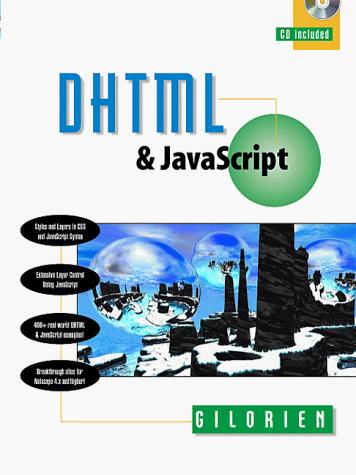
DHTML and JavaScript


Gilorien
cascading style sheets, Java Script style sheets, & Java Scripted layers plus advanced Java Script 1.2 & 1.3
Gilorien
Published 2000 by Prentice Hall PTR in Upper Saddle River, NJ .
Written in English.
Edition Notes

"The accompanying CD-ROM contains all of the working examples from the book and two hyperlinked versions of the book, which include a more extensive HTML Elements Primer, in both HTML and PDF formats, with 100+ bonus code examples"--P. [4] of cover

Includes index

Systems requirements: BBEdit HTML examples are intended to run on the Netscape Navigator/Communicator browser; text editor for viewing or edited source code

Contents
Preface xvi
Regarding HTML Syntax xviii
Regarding Java Script Syntax xviii
Regarding Section Header Capitalization xix
About the CD-ROM xx
Part I Dynamic HTML
C h a p t e r 1 S t y l e S h e e t s 1
Introduction to Style Sheets 4
1.1) Style Sheets Overview 4
1.2) The Golden Rules for Styles 6
1.3) Cascading Style Sheets & Java Script Style Sheets 8
Cascading Style Sheets 8
1.4) CSS Syntax Property Chart 11
1.5) CSS & Java Script Syntax Property Comparison Chart 12
1.6) CSS Layer Properties and Attributes Chart 13
1.7) Java Script Layer Object Properties Chart 14
1.8) Generic { font-family: } Names Chart 14
1.9) Styles Chart for HTML Elements 15
The Element 1 6
1.10) Handling Comments in Styles 18
1.11) Element Style 20
Cascading Style Sheet Properties 2 3
1.12) The { font-size: } Property 23
1.13) The { font-family: } Property 24
1.14) The { font-weight: } Property 25
1.15) The { font-style: } Property 25
1.16) The { line-height: } Property 27
1.17) The { text-decoration: } Property 28
1.18) The { text-transform: } Property 28
1.19) The { text-align: } Property 28
1.20) The { text-indent: } Property 29
1.21) Margins Overview 30
1.22) The { margin: } Property 31
1.23) The { margin-top: } Property 32
1.24) The { margin-right: } Property 32
1.25) The { margin-bottom: } Property 32
1.26) The { margin-left: } Property 32
1.27) Padding Overview 34
1.28) The { padding: } Property 34
1.29) The { padding-top: } Property 35
1.30) The { padding-right: } Property 35
1.31) The { padding-bottom: } Property 35
1.32) The { padding-left: } Property 35
1.33) Color Overview 37
1.34) The { color: } Property 38
1.35) The { background-color: } Property 40
1.36) The { background-image: } Property 42
1.37) Setting Borders Overview 46
1.38) The { border-style: } Property 46
1.39) The { border-color: } Property 48
1.40) Border Widths 52
1.41) The { border-width: } Property 52
1.42) The { border-top-width: } Property 53
1.43) The { border-right-width: } Property 53
1.44) The { border-bottom-width: } Property 53
1.45) The { border-left-width: } Property 53
1.46) The { width: } Property 59
1.47) Horizontal Alignment, Floating, and Clear 62
1.48) The { float: } Property 62
1.49) The { clear: } Property 64
1.50) The { white-space: } Property 66
1.51) The { list-style-type: } Property 68
Using Styles in the Element 7 2
1.52) Element with CLASS of STYLE 72
1.53) Naming your CLASS of STYLE 74
1.54) Defining a CLASS of STYLE without attaching it to an Element 75
1.55) The Keyword all 75
1.56) Attaching the same CLASS to more than one Element 78
1.57) Bordered Link workaround example 81
1.58) Element with ID Definition for CLASS Exceptions 83
1.59) Styles and Tables 85
1.60) Element with CONTEXTUAL SELECTION CRITERIA 93
1.61) Inheritance issues for CONTEXTUAL STYLEs 98
1.62) CONTEXTUAL SELECTION with CLASSes of STYLE and NAMED INDIVIDUAL STYLEs 99
More Style Uses 1 0 4
1.63) The STYLE Attribute 104
1.64) The Element 105
1.65) The Element with STYLE Attribute 106
1.66) The Element with CLASS Attribute 110
1.67) The Element with ID Attribute for CLASS Exceptions 112
1.68) External Style Sheets with the Element 114
1.69) The
  • Element 114
    1.70) Multiple External Style Sheets in one document 121
    1.71) External Style Sheet precedence issues 121
    1.72) Multiple Elements in one document 123
    C h a p t e r 2 L a y e r s & S t y l e s 1 2 7
    Creating Layers with Styles 129
    2.1) Overview 129
    Creating Layers with CSS Syntax 130
    2.2) Creating a LAYER with the STYLE Attribute 130
    2.3) Creating a LAYER with a CLASS of STYLE 131
    2.4) The { position: } Property 132
    2.5) The { left: } Property 132
    2.6) The { top: } Property 133
    2.7) The NAMED LAYER Style ( Creating a LAYER with the ID Attribute ) 135
    2.8) The { width: } Property 136
    2.9) The { height: } Property 137
    2.10) The { clip: } Property 139
    2.11) The bugged version of the { clip: } Property 139
    2.12) The unbugged version of the { clip: } Property 142
    2.13) The { z-index: } Property 146
    2.14) The { visibility: } Property 149
    2.15) The { layer-background-color: } Property 151
    2.16) The { layer-background-image: } Property 152
    2.17) The { include-source: } Property 158
    2.18) CSS Layer Properties and Attributes Chart 161
    Creating Layers with the Element 162
    2.19) The Element 162
    2.20) The Element 173
    2.21) The Element 176
    C h a p t e r 3 L a y e r s & J a v a S c r i p t 1 7 9
    Introducing Java Script Layers 182
    3.1) Overview 182
    3.2) Style Sheet Comments for Java Script Syntax 182
    New Java Script Properties 183
    3.3) New document Object Properties 183
    3.4) The tags Property 183
    3.5) The classes Property 185
    3.6) The ids Property 187
    Java Script Style Sheets 189
    3.7) Java Script Style Sheets 189
    3.8) Using the with() Statement 189
    3.9) The Java Script Keyword all 190
    3.10) The contextual() Method 191
    3.11) Java Script Style Sheet Properties & Examples Chart 194
    3.12) Java Script Style Sheet Properties & All Values Chart 195
    Java Script and Layers 196
    3.13) The JSS position Property 196
    3.14) The HTML Element 196
    3.15) Comment Tag to hide the contents of the Element 197
    3.16) The Java Script Keyword var 198
    3.17) The Java Script Layer Object 199
    3.18) The Java Script layers[i] Array 199
    3.19) The two types of document Objects 200
    Properties of the Layer Object 203
    3.20) Properties of the Layer Object — Chart 203
    3.21) The document Property of the Layer Object 204
    3.22) Invoking Methods on a Layer Object 204
    3.23) The Layer Object name Property 205
    3.24) The Layer Object left Property 205
    3.25) The Layer Object top Property 206
    Methods of the Layer Object 216
    3.26) The Layer Object pageX Property 207
    3.27) The Layer Object pageY Property 207
    3.28) The Layer Object visibility Property 208
    3.29) The Layer Object zIndex Property 209
    3.30) The Layer Object siblingAbove Property 209
    3.31) The Layer Object siblingBelow Property 210
    3.32) The Layer Object above Property 210
    3.33) The Layer Object below Property 210
    3.34) The Layer Object parentLayer Property 211
    3.35) The Layer Object and Clipping Rectangles 211
    3.36) Default Values for the Clipping Properties 212
    3.37) The Layer Object clip.top Property 212
    3.38) The Layer Object clip.left Property 212
    3.39) The Layer Object clip.bottom Property 213
    3.40) The Layer Object clip.right Property 213
    3.41) The Layer Object clip.width Property 213
    3.42) The Layer Object clip.height Property 214
    3.43) The Layer Object bgColor Property 214
    3.44) The Layer Object background Property 215
    3.45) The Layer Object sr c Property 215
    3.46) The moveBy(dx, dy) Method 217
    3.47) The moveTo(x, y) Method 217
    3.48) The moveToAbsolute(x, y) Method 218
    3.49) The resizeBy(dwidth, dheight) Method 218
    3.50) The resizeTo(width, height) Method 219
    3.51) The moveAbove(layerName) Method 220
    3.52) The moveBelow(layerName) Method 221
    3.53) The load("sourceURL", newPixelWidth) Method 221
    Using Java Script with Layers 230
    3.54) The Java Script write() Method 230
    3.55) Using the write() & close() Methods 230
    3.56) Using the moveAbove() Method 232
    3.57) Show & Hide Layers & writing Layer content 236
    3.58) The new Operator for creating new Layers in real-time 240
    3.59) Dynamically create new Layers with tags Property Style 241
    3.60) Localized Java Script s within a Layer 246
    3.61) Animating a Clipping Rectangle to reveal an Image 250
    3.62) The Java Script setTimeout() Method 250
    3.63) The Java Script clearTimeout() Method 250
    3.64) Animating Clipping Rectangles and popping Images 251
    3.65) Some Java Script Tips 264
    3.66) Animating control Layers and Images offscreen and onscreen 264
    3.67) The Java Script setInterval() Method 284
    3.68) The Java Script clearInterval() Method 284
    3.69) Three examples to cycle through Background Colors repeatedly 285
    3.70) A Tic Tac Toe game example 296
    3.71) The Java Script Date Object 307
    3.72) Creating Date Objects with the four Date Constructors 308
    3.73) Creating a Time Counter and Displaying the Current Time 308
    3.74) Creating a Time Counter and Displaying the Current Time in a Frameset 310
    3.75) The Java Script Conditional Operator ? : 316
    3.76) The Java Script Math Object 321
    3.77) Math Object Property Summaries 322
    3.78) Math Object Method Summaries 322
    3.79) Randomly load different Background Images into a Layer 323
    3.80) Using Math Methods in a quasi-calculator 325
    3.81) Math Methods of Math.max(x,y), Math.min(x,y) and Math.pow(x,y) 334
    3.82) The Java Script toString() Method 336
    3.83) The Java Script parseFloat() Function 337
    3.84) The Java Script parseInt() Function 337
    3.85) The Java Script isNaN() Function 338
    3.86) The Java Script charAt() Method 338
    3.87) The Java Script split() Method 338
    3.88) The Java Script slice() Method 339
    3.89) The length Property of String Object 339
    3.90) A really cool color conversion calculator 340
    3.91) A compilation example with border animation and music 351


    Part II Java Script 1.2
    C h a p t e r 4 O b j e c t s & F u n c t i o n s 3 6 3
    Java Script Objects 366
    4.1) The Java Script Object Hierarchy 366
    4.2) Using Java Script Objects 367
    4.3) Object Properties and Methods 367
    Java Script Functions 371
    4.4) Defining a Function with the Function Statement 371
    4.5) Calling a Function by Attribute Assignment 372
    4.6) Calling a Function by Name 373
    4.7) Calling a Function from within a Function 375
    4.8) Calling a Function by Property Assignment 376
    4.9) The Java Script Core Function Object 378
    4.10) The arguments[i] Array Property of a Function 380
    4.11) Nesting a Function within a Function 384
    Summaries Charts 386
    4.12) Predefined Java Script Objects 386
    4.13) Predefined JavaS cript Arrays as Object Properties 387
    4.14) Predefined Java Script Core Objects 388
    4.15) Predefined Java Script Core Functions 388
    The Java Script Core Object 389
    4.16) The Java Script Core Object Overview 389
    4.17) Creating Objects with its Constructor Function 390
    4.18) Creating Methods for an Object 392
    4.19) An Object as a Property in an Object Definition 396
    4.20) The prototype Property to add a Method to an Object Type 399
    4.21) Add a Property to an Object Instance after it is defined 402
    4.22) The prototype Property to add a Property to an Object Type 402
    4.23) Indexing Properties of an Object 404
    4.24) Creating Objects with Literal Notation 407
    4.25) Deleting an Object 411
    4.26) The watch() Method of the Core Object 411
    4.27) The unwatch() Method of the Core Object 415
    Predefined Java Script Objects 416
    4.28) The Java Script window Object 416
    4.29) The open() Method of the window Object 422
    4.30) The close() Method of the window Object 427
    4.31) The scrollBy() Method of the window Object 430
    4.32) The Java Script document Object 432
    4.33) The cookie Property of the document Object 436
    4.34) The Java Script screen Object 445
    4.35) The Java Script Location Object 447
    4.36) The Java Script History Object 452
    4.37) The Java Script navigator Object 456
    4.38) Creating Frames on the fly 457
    4.39) The Java Script Number Core Object 460
    4.40) The Java Script select Object 462
    4.41) The Java Script options[i] Array 464
    4.42) The Java Script option Object 465
    New JavaScript Core Functions 467
    4.43) The Java Script Number Core Function 467
    4.44) The Java Script String Core Function 468
    C h a p t e r 5 S t a t e m e n t s & O p e r a t o r s 4 7 1
    Java Script Statements 473
    5.1) What are Java Script Statements 473
    5.2) Categories of Statements 473
    5.3) Chart of all Java Script Statements 474
    Conditional Statements 475
    5.4) The Java Script if () Statement 475
    5.5) The Java Script if ()...else Statement 477
    5.6) Nested if () Statement 478
    5.7) Nested if ()...else Statement 479
    5.8) The ( ) ? : Conditional Operator Statement 480
    5.9) The switch( ) Statement 481
    Loop Statements 484
    5.10) The for( ) Statement 484
    5.11) The while( ) Statement 486
    5.12) The do while( ) Statement 488
    5.13) The labeled : Statement 490
    5.14) The break Statement 491
    5.15) The continue Statement 494
    Object Manipulation Statements 498
    5.16) The for...in Statement 498
    5.17) The with( ) Statement 500
    5.18) The with( ) Statement in a Element 502
    5.19) The var Statement 503
    5.20) The function Statement 505
    5.21) The return Statement 506
    5.22) The export Statement 506
    5.23) The imprt Statement 507
    5.24) The delete Statement 508
    Comment Statements 508
    5.25) Single & multiple-line Comment Statements 508
    Java Script Operators 509
    5.26) What are Java Script Operators? 509
    5.27) Categories of Operators 510
    5.28) Special Operators 510
    5.29) The Keyword new Operator 510
    5.30) The Keyword this Operator 510
    5.31) The Keyword typeof Operator 512
    5.32) The Keyword void Operator 514
    5.33) The ( , ) comma Operator 514
    5.34) Comparison Operators 515
    5.35) Arithmetic Operators 515
    5.36) String Operators 516
    5.37) Logical Operators 516
    5.38) Assignment Operators 517
    5.39) Bitwise Operators 517
    Java Script Expressions 518
    C h a p t e r 6 J a v a S c r i p t E v e n t s 5 2 1
    Event Objects & Handlers 524
    6.1) The Java Script Event Model 524
    6.2) Java Script Event Objects and Event Handlers 525
    6.3) Event Properties Summaries Chart 526
    6.4) Modifiers Keys and ASCII Values Chart 527
    6.5) The Structure of an Event Object 527
    6.6) Specifying an Event by name with dot notation 528
    6.7) Available Event Properties for each Event Object 529
    6.8) Defining Event Handlers 530
    6.9) Defining Event Handlers by Property Assignment 530
    6.10) Testing for Modifiers Keys in Conditionals 530
    6.11) Defining Event Handlers by Attribute Assignment 532
    6.12) The Java Script event Keyword 532
    6.13) Testing for Multiple Modifiers Keys in Conditionals 534
    6.14) Testing for Modifiers Keys pressed during Mouse Events 535
    6.15) The load() Method of the Layer Object with Key Events 536
    6.16) The fromCharCode() Method of the String Object with Key Events 538
    6.17) Using Modifiers Keys with Regular Keys to Trigger Events 540
    6.18) Determining the ASCII Value of a Pressed Key 541
    Capturing & Releasing Events 543
    6.19) The Java Script captureEvents() Method 543
    6.20) Capturing Events in Nested Layers 543
    6.21) The Java Script releaseEvents() Method 544
    6.22) Using the type Property and captureEvents() Method on a Layer 544
    6.23) Dragging an Image with the Mouse 547
    6.24) The name Property of the target Property of the Event Object 549
    6.25) Capturing Events for the window Object to Drag an Image 553
    6.26) Using Localized Scripts to Drag an Image 556
    6.26.1) The Chess Game Example 556
    6.27) Capturing and using KEYPRESS and KEYUP Events 580
    6.27.1) Tic Tac Toe played from the Keyboard 580
    6.28) Using the Java Script switch() Statement & KEYDOWN, KEYPRESS, and KEYUP Events 586
    6.29) Moving Layers with the switch() Statement 588
    6.30) Animating Layers and Images 590
    6.31) Animating Layers automatically and by clicking on an Image 591
    6.32) Animating Layers with the e.target.name Property 595
    6.33) Animating Layers in a Frameset environment 604
    6.34) Controlling an External Frame document with Java Script 609
    6.35) The Java Script linkColor, alinkColor and vlinkColor Properties 610
    6.36) Using Key Events to hide and show Layers 610
    Scrolling, Resizing, & Moving Windows with Key Events 622
    6.37) The Java Script scrollBy() Method 622
    6.38) The Java Script scrollTo() Method 622
    6.39) Controlling your Window with a variety of Methods 623
    6.40) ASCII Values for the which Property of the Event Object 628
    6.41) Using Key Events to open a new Window 648
    6.42) Creating user-customizable Documents 650
    6.43) Drag on a Layer to Resize it 661
    Routing & Handling Events 663
    6.44) The Java Script routeEvent(e) Function 663
    6.45) Using the Java Script routeEvent(e) Function 663
    6.46) The Java Script handleEvent(e) Method 668
    6.47) Using the Java Script handleEvent(e) Method 669
    6.48) Handling and Routing Events in Nested and Unnested Layers 673
    C h a p t e r 7 J a v a S c r i p t A r r a y s 6 7 9
    J a v a S c r i p t A r r a y O b j e c t s 6 8 1
    7.1) The Java Script Array Object 681
    7.2) Create an Array with the Array Object Constructor 681
    7.3) Create a dense Array 683
    7.4) Create an Array with Literal notation 685
    7.5) Creating Two-Dimensional Arrays 687
    7.6) Creating Three-Dimensional Arrays 690
    7.7) Array Property Summaries 693
    7.8) Array Method Summaries 693
    7.9) An Overview Example that uses all of the Array Methods 694
    A r r a y O b j e c t M e t h o d s 6 9 6
    7.10) The concat() Method of the Array Object 696
    7.11) The join() Method of the Array Object 703
    7.12) The pop() Method of the Array Object 705
    7.13) The push() Method of the Array Object 707
    7.14) The shift() Method of the Array Object 709
    7.15) The unshift() Method of the Array Object 711
    7.16) The slice() Method of the Array Object 713
    7.17) The splice() Method of the Array Object 716
    7.18) The toString() Method of the Array Object 719
    7.19) The toString() Method of the Array Element 719
    7.20) The reverse() Method 722
    7.21) The sort() Method 722
    7.22) The compareFunction Function 723
    Working with returned Arrays 729
    7.23) Working with returned Arrays and Regular Expressions 729
    7.24) The returned Array from the match() Method of String Objects 729
    7.25) The returned Array from the match() Method with the "g" Flag 731
    7.26) The returned Array from the exec() Method of RegExp Objects 733
    7.27) The index Property of the Array Object 735
    7.28) The returned Array from the split() Method of String Objects 736
    7.29) The input Property of the Array Object 739
    7.30) Using Arrays to fill Element Data Dynamically 740
    7.31) Chart of Sample Files that use Arrays 745
    C h a p t e r 8 J a v a S c r i p t S t r i n g s 7 4 7
    Java Script String Objects 749
    8.1) The Java Script String Object 749
    8.2) String Object Property Summaries 750
    8.3) String Object Method Summaries 750
    8.4) Using the String Object Constructor Function 752
    8.5) Create a String Object with Literal notation 752
    8.6) Java Script Special Characters in Strings 753
    8.7) String Object Character Array 754
    Manipulative String Object Methods 755
    8.8) The concat() Method of String Object 755
    8.9) The charAt() Method of String Object 759
    8.10) The charCodeAt() Method of String Object 761
    8.11) The fromCharCode() Static Method of String Object 763
    8.12) The indexOf() Method of String Object 766
    8.13) The lastIndexOf() Method of String Object 769
    String Object Methods used with Regular Expressions 770
    8.14) The search() Method of String Object 771
    8.15) The match() Method of String Object 774
    8.16) The replace() Method of String Object 778
    8.17) The split() Method of String Object 782
    More String Object Methods 788
    8.18) The slice() Method of String Object 788
    8.19) The substring() Method of String Object 790
    8.20) The substr() Method of String Object 792
    Creating Anchors & Links 794
    8.21) The anchor() Method of String Object 794
    8.22) The link() Method of String Object 795
    Decorative Methods of String Object 797
    8.23) Overview 797
    8.24) The toLowerCase() Method of String Object 797
    8.25) The toUpperCase() Method of String Object 798
    8.26) The fontcolor() Method of String Object 798
    8.27) The fontsize() Method of String Object 798
    C h a p t e r 9 J a v a S c r i p t R e g E x p s 8 0 1
    J a v a S c r i p t R e g E x p O b j e c t s 8 0 3
    9.1) Regular Expression Objects Overview 803
    P r e d e f i n e d R e g E x p O b j e c t 8 0 4
    9.2) The Predefined RegExp Core Object 804
    9.3) The input Property of the Predefined RegExp Core Object 805
    9.4) The multiline Property of the Predefined RegExp Core Object 806
    9.5) Property Summaries of the Predefined RegExp Core Object 807
    I n d i v i d u a l R e g E x p O b j e c t s 8 0 8
    9.6) RegExp Objects created with Literal notation 808
    9.7) RegExp Objects created with its Constructor Function 809
    9.8) Patterns in Regular Expressions 810
    9.9) Literal Characters in Patterns in Regular Expressions 810
    9.10) Special Characters in Patterns in Regular Expressions 811
    9.11) Parentheses in Patterns in Regular Expressions 812
    9.11.1) Parenthesized SubStrings 812
    9.12) Exploring Regular Expressions 813
    9.13) Chart of all Special Characters for Regular Expressions 814
    9.14) Method Summary of Individual RegExp Objects 819
    9.15) Summary of String Methods used with Individual RegExp Objects 819
    9.16) Property Summary of Individual RegExp Objects 820
    9.17) The test() Method of Individual RegExp Objects 821
    9.17.1) When to test() or exec() 821
    9.18) The exec() Method of Individual RegExp Objects 825
    9.19) The compile() Method of Individual RegExp Objects 830
    9.20) The lastIndex Property of Individual RegExp Objects 832
    9.21) Example to verify phone number using Regular Expressions 838
    9.22) exec() & match() Method differences 840
    9.23) Example to verify name & address using Regular Expressions 843
    9.24) A full Regular Expression example 845
    9.25) Creating a Search Engine example 847
    Part III Java Script 1.3
    C h a p t e r 1 0 W h a t ' s N e w & C h a n g e d 8 5 3
    What's New in Java Script 1.3 & Changed in Java Script 1.2 855
    10.1) Overview of Features 855
    10.2) Java Script 1.3 and ECMA-262 Compliance 855
    10.3) Java Script 1.3 and Unicode 856
    10.3.1) Unicode Character Escape Sequences 857
    Changes to Objects 858
    10.4) Changes to the Array Object 858
    10.5) Changes to the Array Constructor 858
    10.6) Change to the length Property of Array Object 859
    10.7) New toSource() Method of Array Object 859
    10.8) Change to the toString() Method of Array Object 860
    10.9) Change to the push() Method of Array Object 861
    10.10) Change to the splice() Method of Array Object 861
    10.11) Changes to the Date Object 862
    10.12) Changes to the Date Constructor 862
    10.13) New Methods for the Date Object 863
    10.14) Changes to preexisting Methods of the Date Object 875
    10.15) Changes to the Function Object 880
    10.16) The apply() Method of the Function Object 880
    10.17) The call() Method of the Function Object 886
    10.18) Changes to the String Object 888
    New Method 892
    10.19) The toSource() Method for several Objects 892
    New Top-Level Properties 894
    10.20) Infinity Property 894
    10.21) NaN Property 894
    10.22) undefined Property 895
    New Top-Level Function 895
    10.23) isFinite() Function 895
    Changes to Top-Level Functions 896
    10.24) eval() Function 896
    New Operators 896
    10.25) The === Operator 896
    10.26) The !== Operator 897
    Changes to Operators 897
    10.27) The == Operator 897
    10.28) The != Operator 897
    Changes to Conditional Test Behaviors 898
    10.29) http://www.blogger.com/img/blank.gif Assignment Behaviors 898
    10.30) null and undefined Values for Objects 898
    Using the Java Script Console to debug your code 898
    Part IV Resources

    Internet - Wikipedia, the free encyclopedia, What is Internet?, internet provider, internet service, get internet, internet games,
    test internet speed, internet 9, internet browser, internet 7 download, internet 8 download, internetexplorer

    Wireless Internet Enterprise Applications

    Teach Yourself THE INTERNET in 24 Hours
    Other Internet Books
    Download
  • Tuesday, January 17, 2012

    Create Your First Website By 3.45 This Afternoon


    Create Your First Website By 3.45 This Afternoon, has launched the author into the Internet marketing spotlight, and is now helping many others to build a successful web business and making money online.

    Chris says, “This 120+ page eBook has been the one defining element of my online success”.

    “I clearly remember when I began how difficult it was to get a ’straight answer’ from anyone regarding how to create a website,” says Farrell. “Most people tried to sell me expensive and unnecessary products, which incidentally were over complicated or full of fluff.”

    Create Your First Website By 3.45 This Afternoon will allow anyone to create their own website within hours. It is a step-by-step guide that covers the whole process with nothing left to chance. It is presented in Chris’s unique, and easy to understand style. The eBook covers everything from purchasing a domain name and setting up a hosting account, through to building and uploading your page to your server.

    Chris Farrell is a 40-year-old Londoner, now living in Beverly Hills. He was totally new to Internet marketing in February 2008. Within six months he was having his first $250 days and within nine months had his first $1000 day.

    The eBook, Create Your First Website By 3.45 This Afternoon was responsible for building his list of subscribers from zero to 15,000 with 12 months. He now teaches others through his membership site, how to use the same eBook to build their subscriber list. The eBook has been downloaded more than 33,000 times.

    Chris takes a simple approach to making money online. He leaves all the hype and broken promises to other marketers.

    “Making money online is a skill. Just like plumbing or carpentry. But like any skill – it can be learned.” Says Chris.

    Chris Farrell has built up an amazing membership site, and a huge band of loyal followers because of his laid back approach and his honesty and integrity.

    Through his membership site, Chris provides a complete training system, designed mainly for newcomers to Internet marketing. Members of his site are provided all the training and resources to build a profitable web based business. They have access to all the products that he uses himself.

    One of those products is Create Your First Website By 3.45 This Afternoon – The Videos. This is a series of 43 videos that follow the eBook of the same name. Chris’s easy to follow teaching style makes creating your first website an absolute breeze.

    Chris Farrell is a great person to learn from if you are serious about building a web business. His membership site provides all the training and resources required to build a successful internet business.

    Other Internet Books
    Download

    Tuesday, November 29, 2011

    An Introduction to HTML and Java Script for Scientists and Engineers


    Contents


    1. Introductory Concepts ............................................................................. 1
    1.1 Introducing the Tools ...................................................................... 1
    1.1.1 What Is an HTML Document?.............................................. 1
    1.1.2 What Is Jav aScript?............................................................... 3
    1.1.3 How Do You Create HTML/Ja vaScript Documents? 4
    1.1.4 Some Typographic Conventions Used in This Book 7
    1.1.5 Where Should I Look for More Information
    about HTML and Jav aScript? .............................................. 7
    1.2 Your First HTML/Jav aScript Documents ....................................... 8
    1.3 Accessing HTML Documents on the Web.................................... 16
    1.4 Another Example .......................................................................... 18

    2. HTML Document Basics......................................................................... 21
    2.1 Documents, Elements, Attributes, and Values .............................. 21
    2.1.1 Essential Elements .............................................................. 21
    2.1.2 Some Other Imp ortant Elements......................................... 22
    2.2 HTML Syntax and Style ............................................................... 29
    2.3 Using the script Element ........................................................... 30
    2.4 Creating and Organizing a Web Site............................................. 31
    2.5 Selecting and Using Colors........................................................... 35
    2.6 Using Cascading Style Sheets ....................................................... 36
    2.7 Another Example .......................................................................... 42

    3. HTML Tables, Forms, and Lists .............................................................. 43
    3.1 The table Element ...................................................................... 43
    3.1.1 Basic Table Formatting....................................................... 43
    3.1.2 Merging Cells across Rows and Columns............................ 45
    3.2 The form Element......................................................................... 49
    3.3 Creating Pull-Down Lists.............................................................. 53
    3.4 Combining Tables and Forms ....................................................... 54
    3.5 E-Mailing the Contents of Forms.................................................. 57
    3.6 The List Elements ......................................................................... 59
    3.7 Another Example .......................................................................... 64
    4. Fundamentals of the Jav aScript Language.................................................... 67
    4.1 Capabilities of Jav aScript.............................................................. 67
    4.2 Some Essential Terminology ........................................................ 69
    4.3 Structure of Jav aScript Code......................................................... 70
    4.3.1 Jav aScript Statements ......................................................... 70
    4.3.2 Statement Blocks ................................................................ 71
    4.3.3 Comments ........................................................................... 71
    4.4 Data and Objects ........................................................................... 73
    4.4.1 Data Declarations and Variables......................................... 73
    4.4.2 Data Types .......................................................................... 74
    4.4.3 Literals ................................................................................ 75
    4.4.4 Case Sensitivity................................................................... 75
    4.4.5 Objects and Methods for Input and Output......................... 76
    4.4.6 String Methods.................................................................... 78
    4.5 Tokens, Operators, Expressions, and Statements.......................... 80
    4.5.1 Tokens................................................................................. 80
    4.5.2 Arithmetic Operators .......................................................... 81
    4.5.3 The Assignment Operator ................................................... 82
    4.5.4 Shorthand Arithmetic/Assignment Operators..................... 83
    4.6 The Jav aScript Math Object.......................................................... 85
    4.7 Comparison Operators and Decision-Making Structures.............. 90
    4.7.1 Relational and Logical Operators ....................................... 90
    4.7.2 The if Construct (Branching Structures) ........................... 90
    4.7.3 The switch Construct........................................................ 95
    4.8 Loop Structures ............................................................................. 97
    4.8.1 Count-Controlled Loops ..................................................... 97
    4.8.2 Conditional Loops............................................................... 99
    4.9 Using Jav aScript to Change Values in Form Fields.................... 102
    4.10 Another Example......................................................................... 105

    5. Using Arrays in HTML/Ja vaScript ........................................................107
    5.1 Basic Array Properties ................................................................ 107
    5.2 Some Operations on Arrays ........................................................ 111
    5.2.1 Manipulating Stacks and Queues...................................... 111
    5.2.2 Sorting............................................................................... 114
    5.3 Creating Two-Dimensional Arrays ............................................. 115
    5.4 Using Arrays to Access the Contents of Forms .......................... 118
    5.4.1 Accessing Values of type= text Fields ...................... 118
    5.4.2 Accessing type= radio and type= checkbox
    Fields................................................................................. 120
    5.5 Hiding the Contents of a Jav aScript Script ................................. 122
    5.6 Another Example ........................................................................ 124
    6. Jav aScript Functions............................................................................. 127
    6.1 The Purpose of Functions in Programming................................. 127
    6.2 Defining Ja vaScript Functions .................................................... 128
    6.3 Using Ja vaScript Functions with HTML Forms ......................... 131
    6.3.1 Using Numerical Values as Input ..................................... 132
    6.3.2 Using Field Name value Attributes as Input................... 135
    6.3.3 Using Field Names as Input.............................................. 135
    6.3.4 Using Entire Forms as Input ............................................. 136
    6.4 Some Global Methods and Event Handlers .............................. 140
    6.4.1 Global Methods .............................................................. 140
    6.4.2 Using Event Handlers with Forms and Functions ............ 143
    6.5 Recursive Functions .................................................................... 144
    6.6 Passing Values from One Document to Another ........................ 149
    6.7 Revisiting the Jav aScript sort() Method ................................. 151
    6.8 More Examples ........................................................................... 152

    Glossary ...............................................................................................

    Appendices .............................................................................................169
    A.1 HTML Document Examples ...................................................... 169
    A.2 Displaying Special Characters in an HTML Document ............. 171

    Exercises...............................................................................................173

    Index ....................................................................................................193
    161

    Another Internet Books
    Another Web Programming Books
    Download

    Wednesday, June 29, 2011

    Teach Yourself THE INTERNET in 24 Hours


    - Introduction -

    Part I - The Basics -

    Hour 1 - The Internet: What's It Really Like? -
    Hour 2 - Internet Uses in the Modern World -
    Hour 3 - Introduction to the World Wide Web -
    Hour 4 - Internet Service Provider Options and Pointers -

    Part II - E-Mail: The Great Communicator -

    Hour 5 - Person-to-Person: Understanding E-Mail -
    Hour 6 - Person-to-Person Communication with E-Mail -
    Hour 7 - Using E-Mail Like the Pros -
    Hour 8 - Communicating with the World: Using Mailing Lists -

    Part III - News and Real-Time Communication -

    Hour 9 - Basic Journalism: Introduction to Newsgroups -
    Hour 10 - Getting the Scoop: Using Newsgroups -
    Hour 11 - Chatting Live on the Internet -
    Hour 12 - Internet Phone and Video -

    Part IV - The World Wide Web -

    Hour 13 - Navigating the Web -
    Hour 14 - Netscape Versus Internet Explorer: Finding the Right Browser -
    Hour 15 - Helping Your Browser with Plug-Ins -
    Hour 16 - Searching the Web for Virtually Anything -
    Part V - Finding Information on the Net -

    Hour 17 - Getting Files with FTP -
    Hour 18 - Gopher Even More -
    Hour 19 - Telnet to the Internet -
    Hour 20 - Finding People, Places, and Things on the Net -

    Part VI - Getting the Most Out of the Internet -

    Hour 21 - The Internet for Home: Entertainment, Travel, and More -
    Hour 22 - Education on the Internet -
    Hour 23 - Taking Care of Business Using the Internet
    Hour 24 - The Internet Just For Fun

    Part VII - Appendixes -

    A - Hot Sites -
    B - Shareware Products for Windows -
    C - Shareware Products for Macintosh -
    Glossary

    Another Internet Books
    Download

    Saturday, April 30, 2011

    Agent Mediated Electronic Commerce II


    Table of Contents
    Shopbots and Pricebots.......................................................................................................1
    Amy R. Greenwald and Jeffrey O. Kephart (IBM T.J. Watson Research Center, USA)
    Civil Agent Societies: Tools for Inventing Open Agent-Mediated Electronic
    Marketplaces.....................................................................................................................24
    Chrysanthos Dellarocas and Mark Klein (Massachusetts Institute of Technology, USA)
    Legal Issues for Personalised Advertising on Internet: The AIMedia Case Study............40
    Vania Conan, Marten Foss, Peter Lenda, Sophie Louveaux, and Anne Salaun
    (AIM Media Project, Spain, and ECLIPSE Project, Germany)
    Energy Resellers - An Endangered Species? ....................................................................68
    Fredrik Ygge (EnerSearch, AB, Sweden)
    Modeling Supply Chain Formation in Multiagent Systems. .............................................94
    William E. Walsh and Michael P. Wellman (University of Michigan, USA)
    Jangter: A Novel Agent-Based Electronic Marketplace..................................................102
    Shim Yoon, Ju Young Yun, SooWoong Kim, and Juneha Kim (Samsung Ltd, Korea)
    Bid Selection Strategies for Multi-agent Contracting in the Presence of
    Scheduling Constraints. .................................................................................................113
    John Collins, Rashmi Sundareswara, Maria Gini, and Bamshad Mobasher
    (University of Minessota, USA and DePaul University, USA)
    Resource Allocation Using Sequential Auctions. ...........................................................131
    Craig Boutilier, Moisés Goldszmidt, Claire Monteleoni, and Bikash Sabata
    (University of Toronto, Canada, and Stanford University, USA)
    Profit-Driven Matching in E-Marketplaces: Trading Composable Commodities. ..........153
    Apostolos Dailianas, Jakka Sairamesh, Vibby Gottemukkala, and Anant Jhingran
    (IBM T.J. Watson, USA)
    Two-Sided Learning in an Agent Economy for Information Bundles.............................180
    Jeffrey O. Kephart, Rajarshi Das, and Jeffrey K. MacKie-Mason
    (IBM T.J. Watson Center, USA, and University of Michigan, USA)
    Optimal Auction Design for Agents with Hard Valuation Problems. .............................206
    David C. Parkes (University of Pennsylvania, USA)
    Auctions without Auctioneers: Distributed Auction Protocols. ......................................220
    Marc Esteva and Julian Padget (IIIA, Spain and University of Bath, UK)
    Author Index.................................................................................................................239

    Another Internet Books
    Another Commerce Books
    Download

    Thursday, April 28, 2011

    Wireless Internet Enterprise Applications


    Contents
    List of Illustrations x
    List of Tables xii
    Acknowledgments xiv
    Introduction xv
    About the Author xx
    Chapter 1 Wireless Internet Enterprise Applications 1
    The Network Computing Model 1
    The Client/Server Model 2
    The Internet-centric Model 4
    A Pervasive Computing Model 6
    Wireless Internet Enterprise Applications 10
    Chapter 2 A Wireless Primer 15
    Basic Wireless Network Architecture 15
    Wireless Data Networks 17
    Basics of Data Transmission 18
    Wireless Network Technologies: Past, Present, and Future 20
    Chapter 3 Market Drivers 25
    Mobile Subscriber Growth and Market Potential 26
    Trends in Component Technologies 27
    Processing Power 27
    Memory 28
    Power Consumption 29
    New Standards and Technologies 29
    Less Powerful CPUs 31
    Limited Memory 31
    Restricted Power Consumption 31
    Small Displays 31
    Difficult Input Devices 32
    Limited Bandwidth 32
    Latency 32
    Standards and Technologies 32
    The Internet Revolution 40
    Wireless Data Moves toward Ubiquity 42
    Need to Streamline Enterprise Information 43
    Convergence of Computing and Communications Industries 43
    Competition 44
    Consumer Awareness and Demand 44
    Chapter 4 The Wireless Internet Applications and Services Landscape 47
    Consumer Applications 47
    Wireless Portals 47
    Personal Organizers 55
    Transactional Services 55
    Ecommerce Services 58
    Entertainment 59
    Communications 60
    Location-Based Services 60
    Corporate Applications 61
    Voice Portals 61
    Enterprise Applications 61
    Dispatch and Deliver 62
    Field Service 63
    Sales Force Automation 63
    Remote IT Monitoring 64
    Remote Access to Intranets 64
    Health Care 64
    Chapter 5 Technology Landscape 67
    Computing Technologies 68
    Transcoding and Markup Languages (MLs) 68
    Wireless Application Protocol 80
    Speech Recognition 82
    Jini 84
    Motion Picture Experts Group 7 (MPEG7) 85
    IP-Based Technologies 86
    Mobile IP 87
    Internet Protocol Version 6 (IPv6) 87
    IPsec 87
    VoIP/FoIP 87
    HTTP-NG 88
    Compression and Encryption 90
    Personalization 91
    Biometrics 94
    Face Recognition 95
    Finger Scanning 95
    Hand Geometry 96
    Finger Geometry 96
    Iris Recognition 96
    Palm Biometrics 96
    Retina Biometrics 96
    Signature Biometrics 96
    Voice Biometrics 97
    False Rejection and False Acceptance 97
    Smart Cards 98
    Synchronization 98
    Mobile Agents 99
    Smart Materials 101
    Eink 101
    Micropayments 102
    Wireless Technologies 103
    Short Message Service (SMS) 103
    Wireless Local and Personal Area Networks (LAN
    and PAN) 104
    Automatic Identification and Data Capture (AIDC)
    Technologies 106
    2.5G and 3G Wireless Technologies 107
    Position Location Technologies 108
    Network-centric Approaches 109
    Handset-centric Approach: The Global Positioning System 113
    Satellite Technologies 115
    Smart Antennas 116
    Technology Ecosystem 116
    Chapter 6 Players 119
    The Value Chain 119
    Content Providers 121
    Aggregators 121
    Middleware Software Providers 122
    System Developers and Service Providers 123
    Voice Recognition 124
    Synchronization 124
    Infrastructure Providers 125
    Network Operators and Wireless Service Providers 126
    Device Manufacturers 130
    Consumers 134
    Chapter 7 Evaluating Wireless Internet Solutions 135
    Extending the Email Platform 136
    Microsoft Exchange 136
    Lotus Notes 139
    Extending Existing Web-Based Applications to
    Wireless Devices 140
    HTML Sites 140
    AvantGo 141
    Palm 142
    Windows CE 143
    Building New Ebusiness Solutions 144
    The Presentation Layer: The User Interface 145
    The Business Logic Layer 146
    The Services Layer 146
    Session Management for Wireless Platforms 147
    HDML or WML? 147
    Developer Tools 149
    WAP 149
    Palm 150
    WinCE 150
    EPOC 151
    ATVEF 151
    VoiceXML 151
    XML 152
    Definition and Implementation Checklist 152
    Requirements 152
    Implementation 153
    Chapter 8 Wireless Internet Strategy: Critical
    Success Factors and Guiding Principles 155
    Clear Strategy and Goal 156
    Competitive Analysis 157
    Affinity of Service and Devices Analysis 157
    Aggregation of Content 158
    Usability 159
    Non-PC Devices 160
    Know Your Users 160
    Interfaces for Handheld Devices 160
    Simplify 162
    Keep Text Concise 162
    Additional Usability Tips 162
    Issues in Developing Speech Recognition-Based Applications 163
    Specifications and Emerging Technologies 163
    Interoperability 164
    Internationalization 164
    Prototypes and Trials 165
    Personalization and Configuration 165
    Security 165
    Forging Synergetic Relationships 166
    Learning from Web Site Building Experience 166
    Billing and Pricing 166
    QoS and SLA 167
    Detection and Prevention of Fraud 168
    Types of Wireless Fraud 169
    Solutions to Wireless Fraud 170
    Credit Card Fraud and Solutions 170
    Mcommerce Fraud and Solutions 171
    Keep It Simple 172
    Respect Consumer Privacy 173
    Existing Infrastructure and Backward Compatibility 173
    Monitor the Network 173
    Chapter 9 Wireless Internet Tomorrow 175
    Semiconductor Technology 176
    Displays and Devices 177
    Biometrics 178
    Networks 180
    The Napster Model 181
    Wireless Internet as an Interface to Technologies 181
    Chapter 10 The Last Word 183
    Enterprise Applications 185
    Expense Reporting 185
    Project Management 186
    IT Network Alarm and Monitoring 187
    Vertical Industry Applications 188
    Health Care 188
    Retail 189
    Transportation 189
    Field Services 189
    Financial Services 190
    Utilities 190
    Conclusion 191
    Appendix A Useful URLs 193
    Appendix B Acronyms 209
    References and Recommended Readings 217
    Index 223


    Another Wireless Network Books
    Another Web Programming Books
    Another Internet Books
    Download

    Thursday, February 17, 2011

    Mastering JXTA: Building Java Peer-to-Peer Applications


    A comprehensive, code-intensive guide to building commercial-quality peer-to-peer applications with JXTA and Java

    Tens of millions of people use peer-to-peer (P2P) applications such as KaZaA, AOL Instant Messenger, and Distributed.net. These applications harness the idle CPU cycles of their host computers to produce enormous databases of information, build powerful processing engines, and enable communication and file-sharing among users around the world. Previously, P2P applications have been built using proprietary technologies and protocols, forcing developers to start from scratch each time they write a new application. Now JXTA, an open source, P2P development technology, enables developers to build P2P applications using Java, XML, and other industry standards.

    With this invaluable book, Joseph Gradecki provides a practical guide to building peer-to-peer applications using Java. He provides detailed descriptions of the JXTA technologies and demonstrates how to build real-world applications. This book also includes:

    * Detailed descriptions of the JXTA specification and the Java reference implementation
    * The complete P2P development process, including how to build reusable application frameworks
    * Fully functional example applications, including a distributed computational engine that can utilize the idle CPU power of thousands of remote machines to solve complex problems, and a fault-tolerant, encrypted network storage system

    The companion Web site includes:

    * All the code listings and complete applications from the book
    * Links to additional JXTA and P2P resources

    Author Biography: Joseph D. Gradecki is a senior software engineer specializing in distributed and Internet systems. He is an associate professor of computer science at Colorado Technical University, where he teaches a wide range of computer science courses, including Java and C++. Gradecki has also written several programming books, including two that explain how to apply peer-to-peer concepts to game development.


    Another Java Books
    Another Internet Books
    Download

    Tuesday, December 14, 2010

    JavaScript for Breakfast


    Let’s face the facts. JavaScript is an essential tool to have in your toolbox. Even if you create your HTML pages with an application that creates scripts for you, there will come a time when you need a script that can’t be automatically generated. There also might come a time when you want to modify one of those scripts. Most impotantly, companies look to hire developers with a diverse toolset. In today’s challenging job market, this can be essential to your success. This book is for anyone with an interest in developing their Javascript skills, the book uses very clear examples that enable you to master the programming language. It’s also a useful reference for developers.

    Table of Contents
    INTRODUCTION................................................................................................................................................ 3
    ABOUT TOM DELL’ARINGA.............................................................................................................................. 3
    PROLOGUE: BECOMING A MASTER DEVELOPER............................................................................................. 4
    BASIC INGREDIENTS – JAVASCRIPT FOR BEGINNERS ..................................................................................... 7
    JAVASCRIPT ZERO TO HERO......................................................................................................................................7
    HOW TO DEBUG JAVASCRIPT .................................................................................................................................17
    TWO DIMENSIONAL ARRAYS AND OTHER GOODIES....................................................................................................25
    OBJECTS......................................................................................................................................................... 34
    BUILDING A JAVASCRIPTOBJECT .............................................................................................................................34
    SCRIPTING THE SELECT OBJECT................................................................................................................................41
    SCRIPTING THE SELECT:MOVING THINGS AROUND ....................................................................................................49
    SCRIPTING THE SELECT;GOING FURTHER....................................................................................................................58
    SCRIPTING THE SELECT: FINISHING UP ........................................................................................................................68
    THE DATE OBJECT..................................................................................................................................................78
    FORMS............................................................................................................................................................ 86
    SCRIPTING FORMS..................................................................................................................................................86
    JAVASCRIPTING USABLE FORMS...............................................................................................................................93
    JAVASCRIPT DISABLING AND ENABLING FORM FIELDS DYNAMICALLY.......................................................................101
    ADVANCED FORMS..................................................................................................................................... 108
    MULTI PAGE FORMS ON ONE PAGE .......................................................................................................................108
    VALIDATING FORMS: A JAVASCRIPT VALIDATION CLASS .........................................................................................120
    EMAIL ADDRESS AND PASSWORD VALIDATION..........................................................................................................129
    FORMATTING USER FORM DATA............................................................................................................................138
    SCRIPTING RADIO BUTTONS WITHOUT TEARS. ............................................................................................................148
    SCRIPTING CHECKBOXES ......................................................................................................................................157
    TAKING IT FURTHER WITH DHTML.................................................................................................................. 170
    MODIFYING PAGE ELEMENTS ON THE FLY .................................................................................................................170
    WORKING WITH THE EVENT LISTENER.......................................................................................................................177
    SPICING UP DATA TABLES WITH HIGHLIGHTING ROWS ...............................................................................................184
    REAL-WORLD JAVASCRIPT ........................................................................................................................... 193
    COOKIE HANDLING.............................................................................................................................................193
    THE JAVASCRIPT DATE PICKER ...............................................................................................................................201
    THE JAVASCRIPT NEWS TICKER..............................................................................................................................216
    DMXZONE.................................................................................................................................................... 225

    Download
    Another Internet Books
    Another Web Programming Books

    Wednesday, December 8, 2010

    Professional Apache Tomcat


    byVivek Chopra, Ben Galbraithet al. ISBN:0764543725
    Wrox Press 2003 (531 pages)
    This book will provide you, the server administrator, with the necessary knowledge to install and configure Tomcat, as well as many of the most popular enhancements to the Tomcat package.


    Table of Contents Back Cover
    Table of Contents
    Professional Apache Tomcat
    Chapter 1 - Apache and Jakarta Tomcat
    Chapter 2 - JSP and Servlets
    Chapter 3 - Tomcat Installation
    Chapter 4 - Tomcat Installation Directory and Architecture
    Chapter 5 - Basic Tomcat Configuration
    Chapter 6 - Web Application Administration
    Chapter 7 - Manager Configuration
    Chapter 8 - Advanced Tomcat Features
    Chapter 9 - Class Loaders
    Chapter 10 - HTTP Connectors
    Chapter 11 - Web Server Connectors
    Chapter 12 - The WARP Connector
    Chapter 13 - The AJP Connector
    Chapter 14 - Tomcat and IIS
    Chapter 15 - JDBC Connectivity
    Chapter 16 - Tomcat Security
    Chapter 17 - Additional Uses for Ant
    Chapter 18 - Log4J
    Chapter 19 - Shared Tomcat Hosting
    Chapter 20 - Server Load Testing
    Appendix A - Axis
    Appendix B - Apache SSL Setup
    Index


    Download
    Another Web Programming Books
    Another Open Source Books
    Another Internet Books

    Sunday, December 5, 2010

    Microsoft SQL Server 2000 Administrator's Companion


    This title is the definitive daily operations guide to planning, deploying, and maintaining Microsoft SQL Server 2000. With it, administrators learn how to use this scalable, high-performance relational database management system to solve complex business challenges, launch Internet-based solutions, and lower the cost and complexity of distributed database solutions. This comprehensive reference introduces new features of both SQL Server 2000 and the Microsoft Windows 2000 operating system. And it includes an expanded section covering installation and setup, an example-rich segment on how to use SQL Server 2000 to create and modify databases, and information about built-in features such as DTC, MTS, and OLAP services. It's the essential daily operations guide for the SQL Server database administrator!

    PUBLISHED BY
    Microsoft Press
    A Division of Microsoft Corporation
    One Microsoft Way
    Redmond, Washington 98052-6399


    Download
    Another Database Books
    Another Web Programming Books
    Another Internet Books

    Saturday, December 4, 2010

    MCSA/MCSE Self-Paced Training Kit (Exams 70-292 and 70-296): Upgrading Your Certification to Microsoft Windows Server 2003


    Contents at a Glance
    Part 1 Learn at Your Own Pace
    Introduction to Windows Server 2003 . . . . . . . . . . . . . . . . . . . . . . . . . . . -1
    Implementing an Active Directory Infrastructure . . . . . . . . . . . . . . . . . . . -1
    Managing and Maintaining an Active Directory Implementation. . . . . . . -1
    Managing Users, Groups, and Computers . . . . . . . . . . . . . . . . . . . . . . . . -1
    Planning, Implementing, and Troubleshooting Group Policy . . . . . . . . . . -1
    Managing the User Environment with Group Policy . . . . . . . . . . . . . . . . . -1
    Planning a Host Name Resolution Strategy. . . . . . . . . . . . . . . . . . . . . . . -1
    Implementing, Managing, and Maintaining Name Resolution. . . . . . . . . -1
    Planning and Implementing Server Roles and Security. . . . . . . . . . . . . . -1
    Managing and Maintaining a Server Environment. . . . . . . . . . . . . . . . .10-1
    Securing Network Communication. . . . . . . . . . . . . . . . . . . . . . . . . . . . .11-1
    Creating and Managing Digital Certificates . . . . . . . . . . . . . . . . . . . . . .12-1
    Managing and Implementing Disaster Recovery . . . . . . . . . . . . . . . . . .13-1
    Clustering Servers. . . . . . . . . . . . . . . . . . . . . . . . . . . . . . . . . . . . . . . . . .14-1
    Part 2 Prepare for the Exam
    15 Exam 70-292—Managing Users, Computers, and Groups (1.0) . . . . . .15-1
    16 Exam 70-292—Managing and Maintaining Access . . . . . . . . . . . . . . .16-1
    to Resources (2.0)
    17 Exam 70-292—Managing and Maintaining a . . . . . . . . . . . . . . . . . . . .17-1
    Server Environment (3.0)
    18 Exam 70-292—Managing and Implementing Disaster . . . . . . . . . . . . .18-1
    Recovery (4.0)
    19 Exam 70-292—Implementing, Managing, and Maintaining Name . . .19-1
    Resolution (5.0)
    20 Exam 70-292—Implementing, Managing, and Maintaining . . . . . . . . .20-1
    Network Security (6.0)
    21 Exam 70-296—Planning and Implementing Server Roles and . . . . . .21-1
    Server Security (1.0)
    22 Exam 70-296—Planning, Implementing, and Maintaining a . . . . . . . .22-1
    Network Infrastructure (2.0)
    23 Exam 70-296—Planning, Implementing, and Maintaining . . . . . . . . . 23-1
    Server Availability (3.0)
    24 Exam 70-296—Planning and Maintaining Network Security (4.0) . . . . 24-1
    25 Exam 70-296—Planning, Implementing, and Maintaining . . . . . . . . . 25-1
    Security Infrastructure (5.0)
    26 Exam 70-296—Planning and Implementing an Active . . . . . . . . . . . . 26-1
    Directory Infrastructure (6.0)
    27 Exam 70-296—Managing and Maintaining an Active . . . . . . . . . . . . . 27-1
    Directory Infrastructure (7.0)
    28 Exam 70-296—Planning and Implementing User, Computer, . . . . . . . 28-1
    and Group Strategies (8.0)
    29 Exam 70-296—Planning and Implementing Group Policy (9.0) . . . . . . 29-1
    30 Exam 70-296—Managing and Maintaining Group Policy (10.0) . . . . . . 30-1

    Download
    Another Web Programming Books
    Another Internet Books
    Another Training Kit Books

    Programming Microsoft .NET XML Web Services


    Author: Karli Watson, Chris Ullman, Daniel Maharry, Damien Foggon

    PUBLISHED BY
    Microsoft Press
    A Division of Microsoft Corporation
    One Microsoft Way
    Redmond, Washington 98052-6399
    Acquisitions Editor: Anne Hamilton
    Interior Graphic Designer: James D. Kramer
    Project Editor: Kathleen Atkins
    Interior Artist: Michael Kloepfer
    Technical Editor: Donnie Cameron
    Proofreader: nSight, Inc.
    Copyeditor: Ina Chang
    Indexer: Bill Meyers
    Principal Compositor: Dan Latimer
    Cover Designer: Methodologie, Inc.

    Copyright © 2004 by Microsoft Corporation

    Get the in-depth reference and guidance you need to create and consume high-performance, cross-platform Web solutions in the Microsoft .NET environment. This exhaustive resource cuts to the heart of developing XML Web Services and their clients offering expert insights on the relevant standards, .NET classes, and key design and development techniques. You ll learn to exploit core technologies such as XML, UDDI, and SOAP, as well as emerging specifications and tools, so that you can create effective and efficient Web Services. You also get complete code in C# for all the book s examples on the Web, ready to adapt to your own applications. Discover how to: Use SOAP to communicate with Web Services and WSDL to define them Know when to use DISCO and UDDI for Web services discovery Write XML schemas to specify the content and context of messages sent to and from clients Create Web methods to manage application state, asynchronous calls, and file versioning Build custom clients for Web Service consumption Use Microsoft ADO.N ET to expose data from databases, XML files, and servers Extend the Web Services framework with HTTP modules and SOAP extensions Use authentication, authorization, SSL connections, cryptography, WS-Security, and other security techniques Employ Web Service Enhancements (WSE) for attachments, routing, referral, and other advanced functions Explore Global XML Web Services Architecture (GXA) and other emerging standards


    Download
    Another XML Books
    Another Internet Books
    Another Web Programming Books
    Another .NET Books

    Friday, December 3, 2010

    Dot NET Web Services Solutions


    by Kris Jamsa ISBN:0782141722
    Sybex © 2003 (440 pages)
    This solutions-oriented book gives you the background you need to understand the concept of web services and quickly moves into showing you how to publish and consume web services.


    Table of Contents
    .NET Web Services Solutions
    Introduction - Why Web Services Will Drive the Growth of the Web
    Part I - Laying the Foundation
    Chapter 1 - Taking Web Services for a Test Drive
    Chapter 2 - Creating Your First Web Services
    Chapter 3 - Accessing Web Services from within HTML Pages
    Chapter 4 - Looking Behind the Scenes at Web Service Protocols
    Chapter 5 - Looking at Key Operations
    Part II - Publishing Your .NET Web Services
    Chapter 6 - Making .NET Web Services Available to Others
    Chapter 7 - Connecting Web Services to Databases
    Chapter 8 - Authenticating Users within .NET Services
    Chapter 9 - Securing Communication between a Web Service and a Client
    Chapter 10 - Extending the Lines of Communication
    Chapter 11 - Integrating Binary Data into .NET Web Services

    Part III - Advanced Concepts
    Chapter 12 - Examining Key Web Service Files
    Chapter 13 - Unlocking Remote Access
    Chapter 14 - Improving Web Page Performance
    Chapter 15 - Making Money with Web Services
    Chapter 16 - Putting It All Together
    Index
    List of Figures
    List of Tables
    List of Code Listings
    List of Sidebars


    Download
    Another Web Programming Books
    Another Internet Books
    Another .NET Books
    Related Posts with Thumbnails

    Put Your Ads Here!